Every content budget conversation eventually hits the same wall: do you invest in a podcast series, commit to branded video, or somehow justify both? The audio-versus-video debate in branded content sounds like a strategic question, but it almost always gets resolved by gut feel, leftover budget, or whoever made the most compelling case in the last planning meeting. That’s a poor foundation for a format decision that will shape your editorial calendar, production spend, and audience relationships for the next 12 months.
This article builds a clear framework for that decision using engagement data, brand recall research, and real production economics. It also makes the case that, for most brands, the choice between audio vs video brand content is a false binary. Full-service studios like StreamBox have made it structurally possible to run both formats from a single production day, which can change the economics significantly, reducing per-asset costs and compressing timelines compared to running two separate production tracks. Here’s what to consider before committing either way.
How audiences consume audio and video brand content
The format decision starts with context, not preference. Your audience doesn’t sit down and choose “audio or video” in the abstract. They choose based on where they are, what they’re doing, and how much attention they have available. Understanding those contexts is what separates a format strategy from a format guess.
When audio-first content takes over
Audio dominates any situation where eyes are occupied. 68% of monthly podcast listeners consume content in their cars, 54% while working, and 51% during exercise. These are long, routine-driven sessions where switching to video simply isn’t possible. Weekly podcast listeners average 6 to 8.5 hours of listening time, hours of brand presence that video cannot access. For brands targeting professionals or knowledge-seeking audiences, that listening window represents a meaningful competitive opportunity worth pursuing through audio branding and podcast marketing.
When video earns full attention
Video performs best when someone is home, on a screen, and choosing to watch. Gen Z and millennial audiences lead video podcast consumption, and 44% of video podcast viewers say they never multitask during a session, compared to 29% of audio-only listeners who say the same. Comedy, entertainment, interviews, and any content where facial expressions, demonstrations, or visual production value add real meaning all favor video. Discovery is also video’s strongest card: first-time listeners typically find new shows through video clips before migrating to audio-only consumption.
What completion rates actually tell you
Podcasts average 60 to 85% episode completion. Short-form video platforms typically land at 12 to 20% completion, based on platform analytics aggregated by trackers like Socialinsider, while long-form YouTube sits somewhere between the two. Before misreading those numbers, consider that 15% completion of a 30-second Reel and 70% completion of a podcast episode are not directly comparable measurements, the first may represent 25 seconds of exposure, while the second may represent 40 minutes of sustained listening. These examples are illustrative rather than drawn from the same dataset, but they reinforce the point: podcasts build depth; short-form video builds frequency and reach. Neither makes the other unnecessary.
What production really costs and how long it takes
Budget conversations about audio vs video brand content almost always start with an assumption gap. Marketers frequently underestimate video complexity and overestimate the simplicity of podcasting. Both deserve a realistic look, because the cost difference shapes how often you can publish and how quickly you can iterate.
The real investment behind a polished branded video
A branded video running 60 to 120 seconds for a mid-size brand typically costs $10,000 to $30,000 and takes 4 to 8 weeks end-to-end. That window covers scripting and pre-production, a 1-to-3-day shoot, and 2 to 4 weeks of post-production including editing, color grading, sound design, motion graphics, and revision rounds. Simpler social-style or product videos can come in at $5,000 to $10,000, but the timeline rarely compresses below three weeks if proper creative development is included. Video production demands more coordination, more specialists, and more client review cycles than most brand teams anticipate.
Podcast production: faster, leaner, but not a casual investment
A professionally produced podcast episode running 30 to 60 minutes typically costs $600 to $2,500 for editing alone, and $2,000 to $6,000 when the full package includes recording, show notes, artwork, captions, and social clips. Turnaround runs 3 to 7 business days post-recording, with the full planning-to-publish cycle sitting at 1 to 3 weeks. The lower cost per episode makes podcast marketing a practical format for brands that need to publish consistently over months. It also makes it the better entry point for brands still defining their content voice.
How batch production changes the economics for both formats
The real cost breakthrough happens when a brand stops thinking in single episodes and starts thinking in production blocks. Multi-episode batch recording, capturing several podcast episodes in a single half-day session, each also recorded on video, can significantly reduce per-episode costs and build weeks of content inventory in one shoot, depending on crew size and edit requirements. This batch model works particularly well for interview series, thought leadership formats, and seasonal content. It also reveals why the audio vs video brand content choice looks very different when the production infrastructure is designed to handle both simultaneously.
Platform distribution: where each format earns its reach
Choosing audio or video without a confirmed distribution plan means producing content for a platform your audience may not actually use. Format strategy and distribution strategy are connected decisions, one should inform the other before production begins.
Audio distributes across Spotify, Apple Podcasts, Amazon Music, and hundreds of podcast apps through a single RSS feed. That structural advantage is real: one submission gets a brand in front of listeners across every major platform without platform-specific reformatting. Spotify has become a significant branded content destination, particularly for brands targeting 18-to-44-year-old professionals. Audio also functions as a media-buying vehicle through host-read sponsor segments and audio ads, giving brands entry into other shows’ established audiences.
Video’s distribution model is more demanding but offers different returns. YouTube remains the dominant long-form platform for brand authority and organic search visibility. LinkedIn video performs strongly for B2B brands reaching decision-makers. TikTok and Instagram Reels serve short-form discovery, particularly for brands targeting Gen Z. Each platform requires different aspect ratios, caption treatments, and hook strategies, which means video distribution demands more post-production resources per asset than audio. The upside: a single well-produced video session can feed multiple platforms through targeted reformatting when vertical clips are built into the original production plan.
A brand that records a strong 45-minute podcast session already holds raw material for a YouTube video, three to five vertical shorts, audiogram clips, quote cards, and a written article. The repurposing bridge runs in both directions: audio recordings become video with minimal additional capture, and video productions can be stripped to audio episodes. Brands that design around this repurposing logic get substantially more output per production day without compromising quality on either format.
Brand recall, attention, and what the research actually shows
The brand lift conversation defaults to video because it’s more visible. The data on audio vs video brand content performance challenges that assumption in meaningful ways.
Audio’s attention advantage in hard numbers
The Dentsu-Lumen Attention Economy study benchmarked audio advertising against a large database of predominantly video and display ads using the same attention framework. Audio produced correct brand recall for 41% of exposures versus a 38% norm, and generated a 10% average lift in brand-choice metrics versus 6% for the comparison group. A follow-up analysis put audio recall 14% higher than online video and display combined. Oxford Road and Podscribe’s 2025 analysis of over 1,000 podcast campaigns across 100-plus brands found that YouTube video views from podcast content were 18 to 25% less effective at driving purchases than audio podcast ads. These are not marginal differences.
What video does better: visual storytelling and emotional range
Video earns its place when the brand story depends on visual demonstration, emotional performance, production design, or product visualization. A brand film can communicate tone and aspiration in ways audio-first content simply isn’t designed to match, and it does so with an immediacy that audio has to work much harder to replicate. For product launches, event coverage, and brand films targeting broad consumer audiences, that visual depth matters. The format also benefits from YouTube SEO and social shareability, giving video-first content a discovery advantage that audio builds more slowly.
How sonic branding amplifies video performance
DVJ Insights isolated the role of audio within video ads and found that six audio brand mentions produced a 39-point lift in brand recall, versus only 9 points from six visual logo appearances. That finding reframes the entire debate: even inside a video, audio cues often do more recall work than the visuals. Brands that invest in a consistent audio identity, a signature motif, recognizable voice, and defined music palette, create recall assets that perform equally well in podcasts, video ads, and branded content series. Audio branding is not a podcast-only strategy. It’s a cross-format investment that strengthens every touchpoint, and it’s one reason sonic branding decisions deserve attention early in any content format discussion.
Audio vs Video Brand Content: Why Choosing One Format Is the Wrong Question
Earlier, we framed audio and video as context-dependent choices. The deeper issue is that most brands treating this as a binary decision are solving the wrong problem entirely. The real question is which format serves which objective, and whether the production infrastructure exists to run both without doubling the budget or the workload.
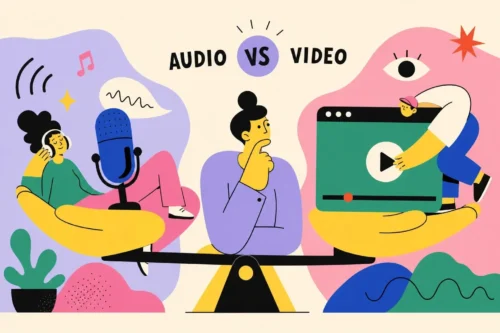
Audio builds depth: it compounds over time, earns listener loyalty, and reaches audiences in moments video cannot access. Video builds visibility: it drives discovery, supports social sharing, and communicates brand craft. These are complementary functions, not competing ones. Research suggests audio can drive stronger conversion in some campaigns while video often drives faster audience growth, meaning a significant portion of any audience will gravitate toward whichever format fits their moment. Forcing a choice between the two means leaving one of those audiences without a touchpoint.
The production barrier to running both formats disappears when the workflow is designed for it from the start. A single recording session captured on camera generates a podcast episode and a video simultaneously. The same transcript yields show notes, social captions, and a written article. Short clips, audiograms, and quote cards all come from the same source material. When this repurposing framework is built into the production plan before the first recording, a brand doesn’t produce twice the content. It produces one asset and distributes it across every channel.
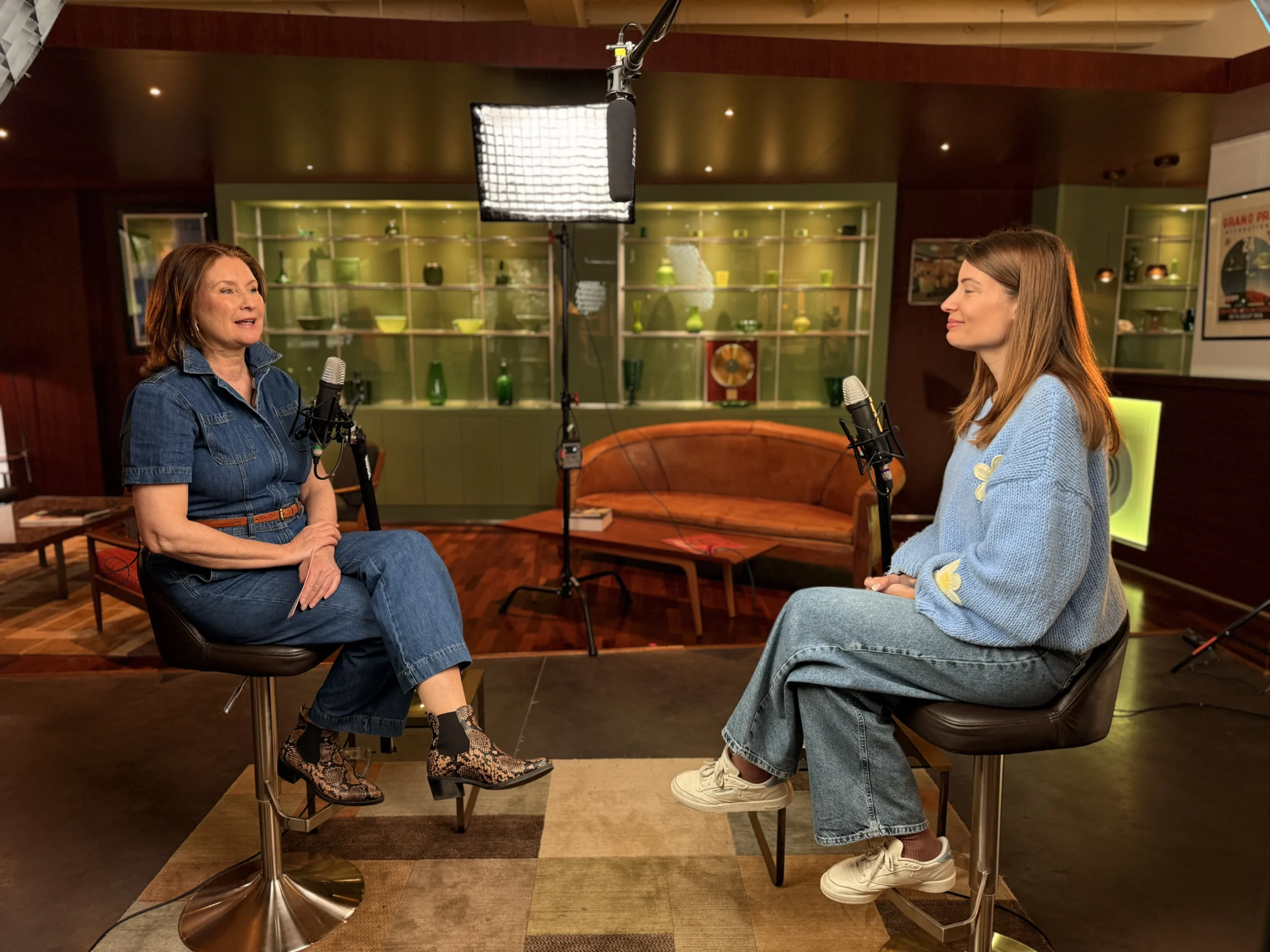
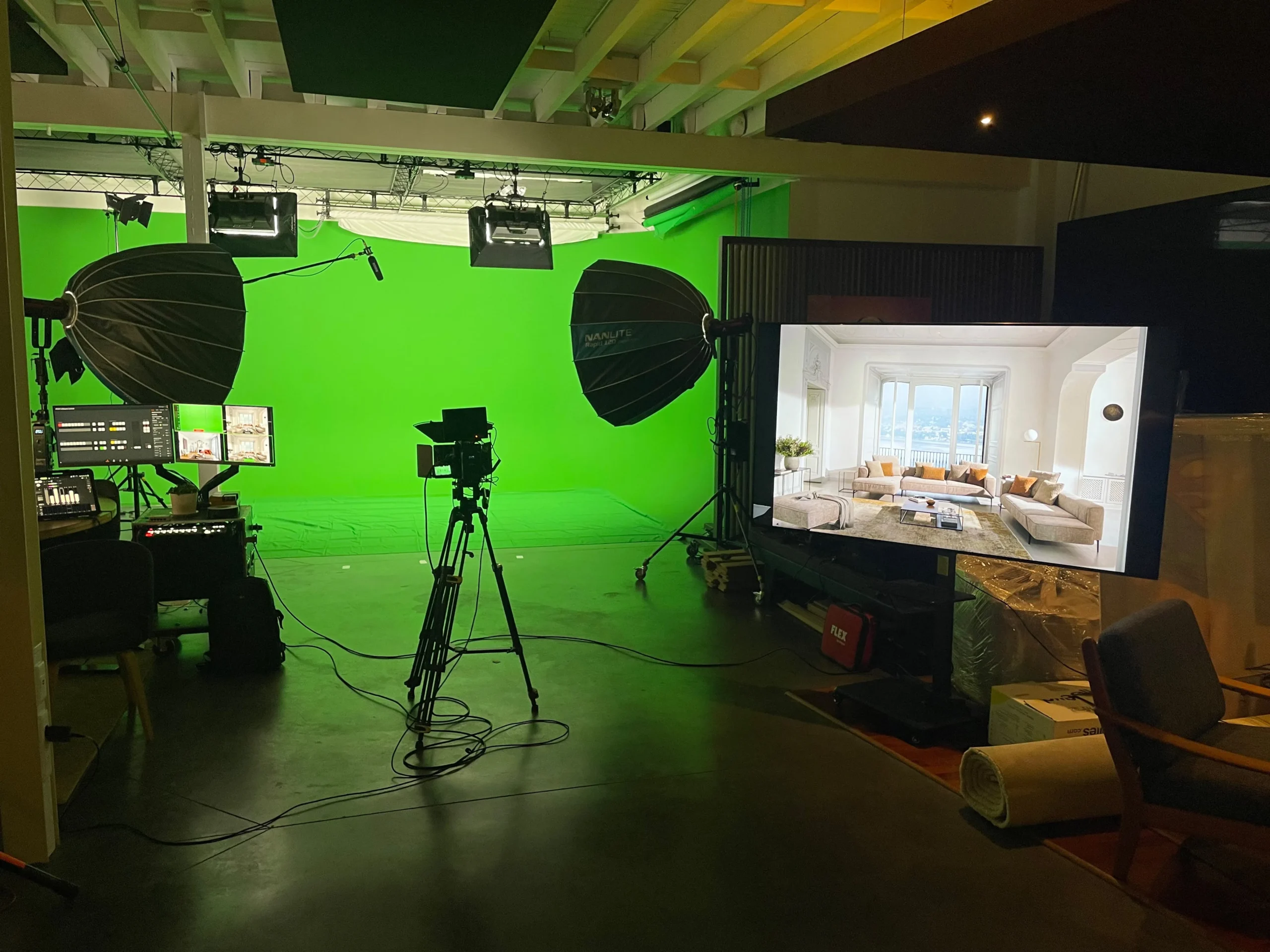
This is exactly the model StreamBox operates from. As a full-service audiovisual production studio based near Brussels, StreamBox handles podcast and video production under the same roof: concept development, scripting, recording, post-production, and multi-platform distribution, all managed by a single project contact. Brands working with StreamBox can record a video podcast in the studio and walk away with a polished audio episode, a full-length video, vertical shorts for TikTok and LinkedIn, and distribution to every major platform from a single session. The choice between audio and video becomes a scheduling decision rather than a budget dilemma.
Building an audio vs video brand content strategy that works for your brand
Before committing to a format, map your objectives to the metrics that actually measure them. Depth, loyalty, and recall in high-attention contexts favor audio. Discovery, visual storytelling, and social sharing favor video. Both formats share the same measurement fundamentals: completion rates, brand lift, qualified traffic, and conversion from content to inquiry. The KPIs don’t change based on format; the benchmarks do.
A practical starting point is to identify which audience context matters most for your next content campaign. If you’re targeting professionals during commutes, working hours, and exercise routines, audio-first is your primary channel. If you’re launching a product or building brand awareness through social discovery, video earns its budget. If you’re building a sustained content presence that needs to reach the same person across multiple daily contexts, both formats serve that goal, and the production economics make dual-format content more accessible than most marketing budgets assume.
The brands making the clearest content format decisions treat audio and video as a system, not a competition. They anchor everything to a unified sonic and visual identity, design production workflows that generate both outputs from a single session, and measure performance at the channel level rather than declaring one format the winner. If your brand is still treating audio and video as separate budget lines with separate creative briefs, that’s the constraint worth solving first. If you want help mapping out an audio vs video brand content approach that fits your goals and budget, reach out to the StreamBox team to see how a single production session can feed your entire content calendar across both formats.