Choosing between building a video team and hiring an agency looks like a straightforward budget decision. It isn’t. The in-house vs agency video production decision has derailed more than a few marketing plans, not because one model is inherently better, but because companies picked based on the wrong variables. They looked at a salary sheet or a project quote, chose the number that felt manageable, and discovered six months later that the real costs were completely different from what they’d planned for.
The right question isn’t “which is cheaper?” It’s “which model fits our content volume, our team structure, and our strategic goals?” Cost follows from those answers, not the other way around. This article gives you the full side-by-side breakdown: what each model actually costs when you load every variable in, where each one breaks down under pressure, what a hybrid structure looks like in practice, and a decision framework you can apply to your specific situation right now.
What it actually costs to build an in-house video team
The most consistently misunderstood number in content marketing budgeting is the fully loaded cost of an in-house video department. Most companies look at base salaries and call it a day. They miss the bigger picture: benefits and overhead commonly add 25 to 35% on top of salary, and equipment and software costs run an additional $8,000 to $25,000 annually before a single frame is shot.
The salary and overhead numbers most budgets miss
A competent 3-person team in 2026, a producer/shooter, an editor, and a motion designer, runs $400,000 to $550,000 annually when you count everything. Base salaries land between $250,000 and $370,000. Employer taxes, benefits, retirement contributions, and paid time off add another $75,000 to $125,000 on top of that.
Software, stock media, review tools, and storage add $8,000 to $25,000 per year. Recruiting overhead, ongoing training, studio, travel, and miscellaneous production expenses push the total further. The practical midpoint for budget planning is around $475,000 per year, or roughly $40,000 per month.
A lean two-person team runs cheaper, closer to $250,000 to $300,000 in year one. That setup works for interview content, webinars, and internal communications. The moment you need motion graphics, simultaneous projects, or campaign-level output, two people become a bottleneck.
First-year setup: the equipment spend companies underestimate
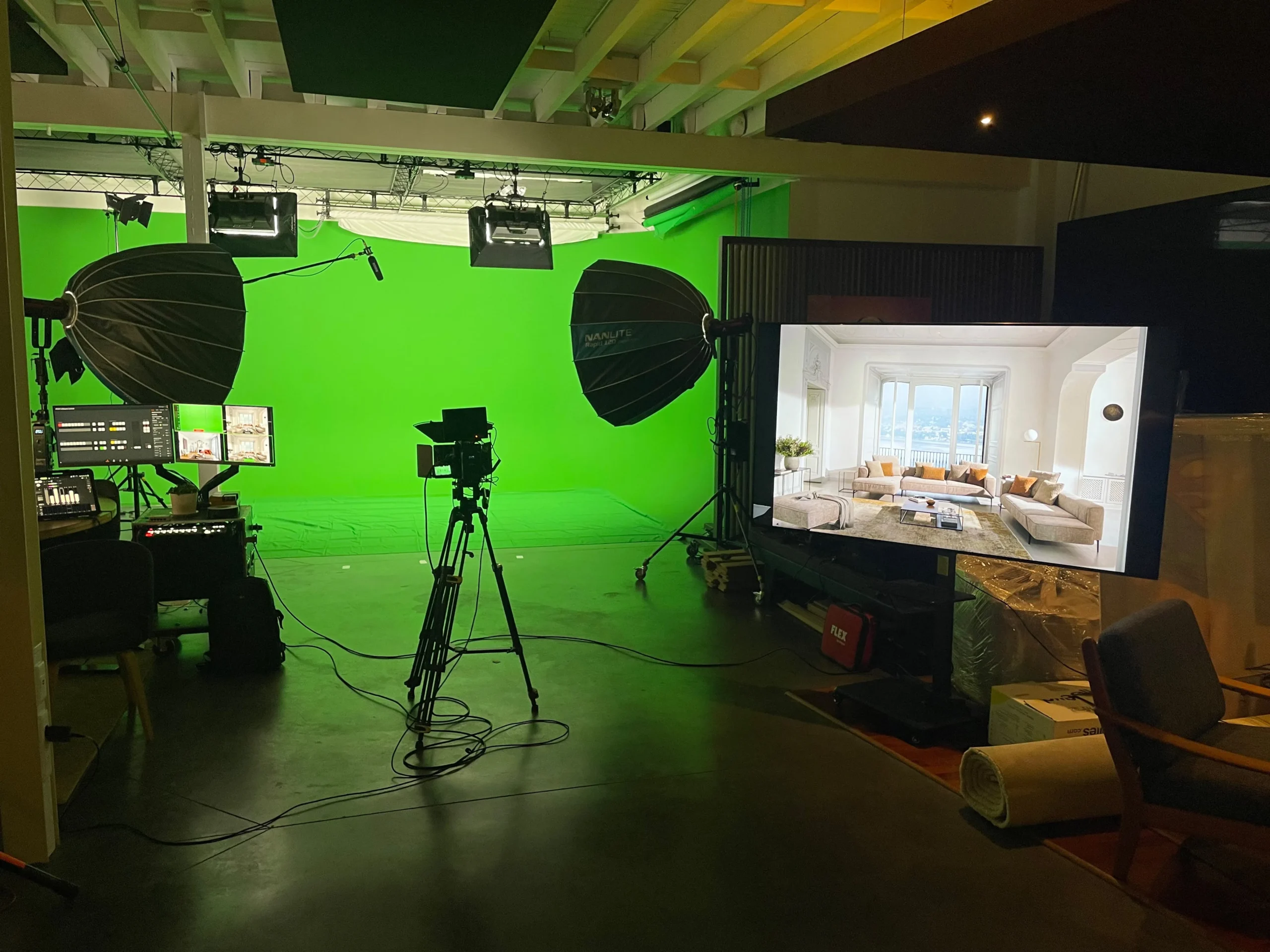
Before anyone records a single frame, you need gear. A professional single-camera setup costs $21,000 to $55,000 upfront, covering a cinema or mirrorless camera body and lenses ($8,000 to $25,000), lighting and grip ($3,000 to $8,000), audio systems ($2,000 to $5,000), an editing workstation with calibrated monitors ($3,000 to $7,000), and studio treatment, teleprompter, and accessories ($2,000 to $5,000). The first year of operating an in-house video department typically runs $35,000 to $75,000 higher than subsequent years because of this initial gear acquisition. That capital commitment rarely appears in the original business case presented to leadership.
In-house vs agency video: how agency pricing works and what you’re actually buying
An agency fee isn’t a line-item expense. It’s a production infrastructure decision. When you hire a production partner, you’re accessing a specialist bench, an editing suite, audio engineering, color grading, distribution capability, and project management without carrying any of that on your payroll. That’s the core value proposition of video production outsourcing: you pay for output, not overhead.
Per-project, retainer, and batch pricing models explained
The three main structures each serve different content strategies. Fixed project fees run $1,500 to $5,000 for a polished 30 to 60-second social ad, and $5,000 to $15,000 for original live-action production. Monthly retainers range from $3,000 to $25,000 depending on output volume and complexity; a production-led retainer at $9,500 to $15,000 per month typically includes a recurring shoot day, 12 to 20 finished assets, scripting, editing, and multi-platform formatting. Per-video batch pricing for social-format content commonly lands at $650 to $1,000 per short when ordering multiple videos together.
For brands running ongoing content, the retainer model frequently delivers the best cost per finished asset. Volume brings efficiency, and an established production relationship closes the briefing and onboarding gap that makes one-off agency work feel slower, particularly when output volume is consistent and briefs are well-defined.
In-house vs agency video, turnaround times and scalability
Turnaround comparisons shift depending on format and relationship structure. Here’s how the two models stack up across common content types:
- Social shorts: In-house delivers same-day to 3 business days for reactive content. A standard agency project takes 2 to 7 business days for the same format.
- 60-second paid ads: In-house averages 2 to 4 weeks; agency runs 3 to 6 weeks on a project basis.
- Product demos: In-house teams with direct product access move in 1 to 5 days. A produced agency demo takes 2 to 3 weeks, longer for complex executions.
- Retainer or embedded agency work: This closes the gap considerably, repeatable social content can turn around in 24 to 72 hours under an established retainer.
The hidden costs that flip the comparison
Sticker price on either model rarely reflects the real number. The costs that actually determine whether each model is worth it tend to show up after the decision is made and the contracts are signed.
What in-house teams cost that never appears in the proposal
Idle capacity is the biggest one. Video demand arrives in bursts: launches, campaigns, quarterly reviews. A team sized to handle those peaks sits underutilized for months while salaries and benefits continue. A single departure from a 3-person team can materially reduce output for weeks to months while hiring and onboarding proceed, a real operational risk that rarely factors into the original business case.
Equipment refresh cycles hit every 3 to 4 years, with annual replacement reserves running 8 to 12% of the original investment. Management overhead, the executive and marketing director hours spent briefing, reviewing, and resolving conflicting feedback, rarely shows up in the production budget but represents a real cost to the organization.
What agency engagements cost beyond the project fee
Agencies carry their own hidden variables. Revision rounds beyond the scoped number add time and fees. Rush work typically adds 25 to 50% to the base cost. Reformatting the hero video into additional aspect ratio variants runs $100 to $400 per cutdown. Music and stock licenses, talent usage rights for paid media, and travel for location shoots often appear as line items the initial quote excluded.
Your internal team still spends time on approvals, briefing calls, and feedback cycles, and that time has a cost even if it doesn’t appear on the invoice. Read the fine print before signing, and clarify how many revision rounds, formats, and platform versions are included as standard.
Creative quality, flexibility, and scalability compared
Neither model is universally superior. Each has a specific operating range where it genuinely outperforms the other. A scorecard that declares a single winner ignores the conditions that actually determine the outcome.
Where an in-house video team has a real edge
In-house teams are faster and more efficient for brand-familiar, reactive content. They already know the product, the stakeholders, the brand guidelines, and the approval chain. For social shorts, internal training videos, and event recaps, that institutional knowledge cuts briefing time dramatically. An internal team can publish content within hours when the situation calls for it. Over time, that familiarity tends to produce stronger creative consistency across a content library, reducing revision cycles and keeping brand standards tight.
Where an agency’s specialist bench changes the outcome
For major campaigns, broadcast-quality ads, multi-location productions, or work requiring motion design, sound engineering, and color grading simultaneously, agencies assemble specialists that would take years to hire internally. When a campaign requires 12 assets in 30 days, an agency can scale production capacity that a 3-person internal team physically cannot match. Agencies also absorb the volume spike without adding headcount to your payroll. For strategically important work where quality is non-negotiable, the specialist bench usually delivers outcomes an internal generalist team can’t replicate regardless of effort.
How the hybrid model works in practice
The hybrid model isn’t a compromise or a fallback. For many mid-market companies, particularly those that need brand control plus occasional specialist capacity, it’s often the most effective structure. The internal team owns the brief, the brand voice, and the stakeholder relationships. The external production partner handles the technical lift, specialist roles, and volume spikes. This avoids the overhead of a full in-house department while keeping creative control inside the organization.
What a working hybrid setup looks like day-to-day
In a functional hybrid, one internal content lead manages briefs, approvals, and distribution strategy. The agency handles scripting, filming, post-production, sound engineering, and platform formatting. The internal team stays close to strategy and stakeholder needs; the agency keeps the production line moving. That structure eliminates the coordination cost that comes from managing five separate vendors for scripting, filming, editing, distribution, and SEO.
How agencies like StreamBox function as a marketing team extension
The model matters more than the category. At StreamBox, every client gets a dedicated project manager assigned from the first brief through final publication. Every revision, deliverable, distribution decision, and platform format runs through one point of contact who knows your brand, your calendar, and your content goals. For brands that need broadcast-ready video, podcast production, social content, and multi-platform distribution under one roof, that single-point accountability changes how content gets made, and how much internal bandwidth it consumes.
A practical decision framework for your business right now
Understanding the models is only half of it. The useful step is mapping your specific situation to the right structure. These three scenarios cover most business cases.
Three scenarios and which model fits each
Scenario 1: You publish fewer than 4 videos per month and have no existing production infrastructure. An agency or hybrid model wins on cost-per-video and time-to-value. Building in-house for that volume means paying for substantial idle capacity, a team sized for peak demand will sit underutilized the majority of the time.
Scenario 2: You publish 8 to 15 assets per month across social, events, and internal communications, and your content is brand-familiar and reactive. A lean 2-person in-house team plus an agency partner for campaign peaks is usually the most efficient structure. Internal handles the reactive cadence; the agency handles volume spikes and production-intensive work.
Scenario 3: You need broadcast-quality campaign work, multi-platform distribution, editorial direction, and consistent delivery at scale. A full-service agency relationship handles this better than an internal generalist team at any size, particularly when the agency manages the full chain from brief to publication.
The KPIs to track once you’ve made the call
Track four metrics to measure whether your production model is working:
- Fully loaded cost per finished video, captures salary, overhead, equipment, and agency fees in one comparable number
- Median time-to-publish by format, reveals where your production pipeline is creating delays
- Cost per qualified view (viewers who reach at least 50% completion), connects production spend to actual audience engagement
- Conversion lift versus a control, ties content investment to measurable business outcomes
These numbers tell you whether your production model is actually working. They also tell you when it’s time to revisit the decision before a misaligned model wastes another quarter of budget.
Making the call that fits your content strategy
In-house production is a capital and headcount commitment that pays off at high, consistent volume with predictable content types. Agency production is a flexible, specialist-backed model that wins on quality, scalability, and campaign complexity. The hybrid structure captures the advantages of both when it’s built around clear role separation: internal owns strategy and stakeholder relationships, external owns execution and production capacity.
Weighing in-house vs agency video options against your KPIs will show which model fits your content strategy. The strongest move for most businesses isn’t choosing one model permanently, it’s matching the production structure to current volume and goals, then revisiting that match as both evolve. If your strategy calls for end-to-end support, a production partner who manages everything from concept to publication eliminates the coordination burden entirely and keeps your internal team focused on the work only they can do.
If you’re working through this in-house vs agency video decision right now and want to understand what a full-service production partnership would look like for your specific content needs, reach out to the StreamBox team. We’ll walk through the numbers with you and help you build the model that actually fits.
Frequently asked questions
When does building an in-house video team make financial sense?
In-house production pays off when you’re publishing at high, consistent volume, typically 8 or more assets per month, with predictable content types that benefit from institutional brand knowledge. Below that threshold, the fully loaded cost of salaries, benefits, and equipment usually exceeds what a retainer-based agency relationship would cost for the same output.
What’s the real cost difference between in-house and agency video production?
A competent 3-person in-house team runs $400,000 to $550,000 annually when you include salaries, employer taxes, benefits, software, and equipment. A comparable agency retainer delivering 12 to 20 assets per month typically ranges from $9,500 to $15,000 per month ($114,000 to $180,000 annually). The comparison shifts based on volume, content complexity, and how consistently the team is utilized.
How does the hybrid model work in practice?
A hybrid setup pairs one internal content lead who manages briefs, approvals, and distribution strategy with an external agency that handles filming, post-production, and platform formatting. Internal owns brand voice and stakeholder alignment; the agency handles production capacity and specialist roles. This structure avoids full in-house overhead while keeping creative control inside the organization.
Is video production outsourcing worth it for smaller marketing teams?
For teams publishing fewer than 4 videos per month, video production outsourcing almost always delivers better cost-per-asset and faster time-to-value than building in-house infrastructure. The break-even point shifts upward as volume increases and content types become more brand-specific and reactive.
What hidden costs should I watch for when hiring a video agency?
The most common surprises are revision rounds beyond the scoped number, rush fees (typically 25 to 50% above base cost), per-cutdown charges for additional aspect ratio formats ($100 to $400 each), and separately licensed music or talent usage rights for paid media. Clarify what’s included as standard before signing any agreement.
Which KPIs best measure video production model performance?
Focus on fully loaded cost per finished video, median time-to-publish by format, cost per qualified view (viewers reaching at least 50% completion), and conversion lift versus a control. These four metrics give you a clear picture of whether your current production structure is delivering business value, and when it’s time to adjust.