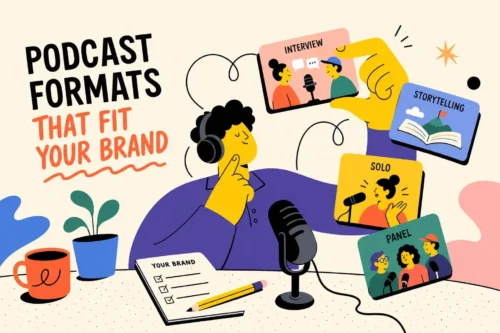
Many brands default to copying what’s popular when launching a podcast, and that’s exactly where the trouble starts. Choosing the best podcast formats for brands requires strategy, not imitation. A competitor runs a weekly interview show, so the instinct is to build a weekly interview show. Narrative podcasts win awards, so the budget goes toward a five-episode documentary series. Format decisions made by imitation rather than intent are a common reason branded podcasts stall after season one. Choosing the right corporate podcast format isn’t just a structural decision. It determines your production budget, your editorial voice, your release cadence, and whether your audience keeps coming back for more.
At StreamBox, the format conversation happens before a single microphone goes live. In our experience, brands with genuinely compelling stories can still fall flat when they choose a panel format that needed to be a solo show, or commit to weekly interviews when their real capacity suits a seasonal narrative. This guide walks through the five formats that consistently work for brands, what each one demands in time and resources, and how to match a format to your messaging goals and audience profile.
Best podcast formats for brands: solo and interview
These two formats are among the most common in branded podcasting, and for good reason. They’re accessible, repeatable, and can be produced at consistent volume without a large production team. For most brands starting out, the real question is which of the two fits the internal talent and editorial direction they already have.
Solo thought leadership: when your executive voice is the brand
One host, one microphone, one clear point of view. The solo format works when your brand has genuine internal expertise worth broadcasting regularly. Think of an executive who can hold 20 minutes on a specific topic without a script that sounds like a script. Production overhead is low, batch-recording multiple episodes in a single session is straightforward, and brand control is tight because there are no external guests introducing unpredictable elements.
The risk is real, though. A solo show lives or dies on the host. If the voice and ideas don’t evolve from season to season, listener fatigue sets in fast. This format is the right fit for founders, C-suite executives, or subject-matter experts who are already building personal authority alongside the brand, not for spokespeople reading from a brief.
Guest interview format: borrowed credibility at scale
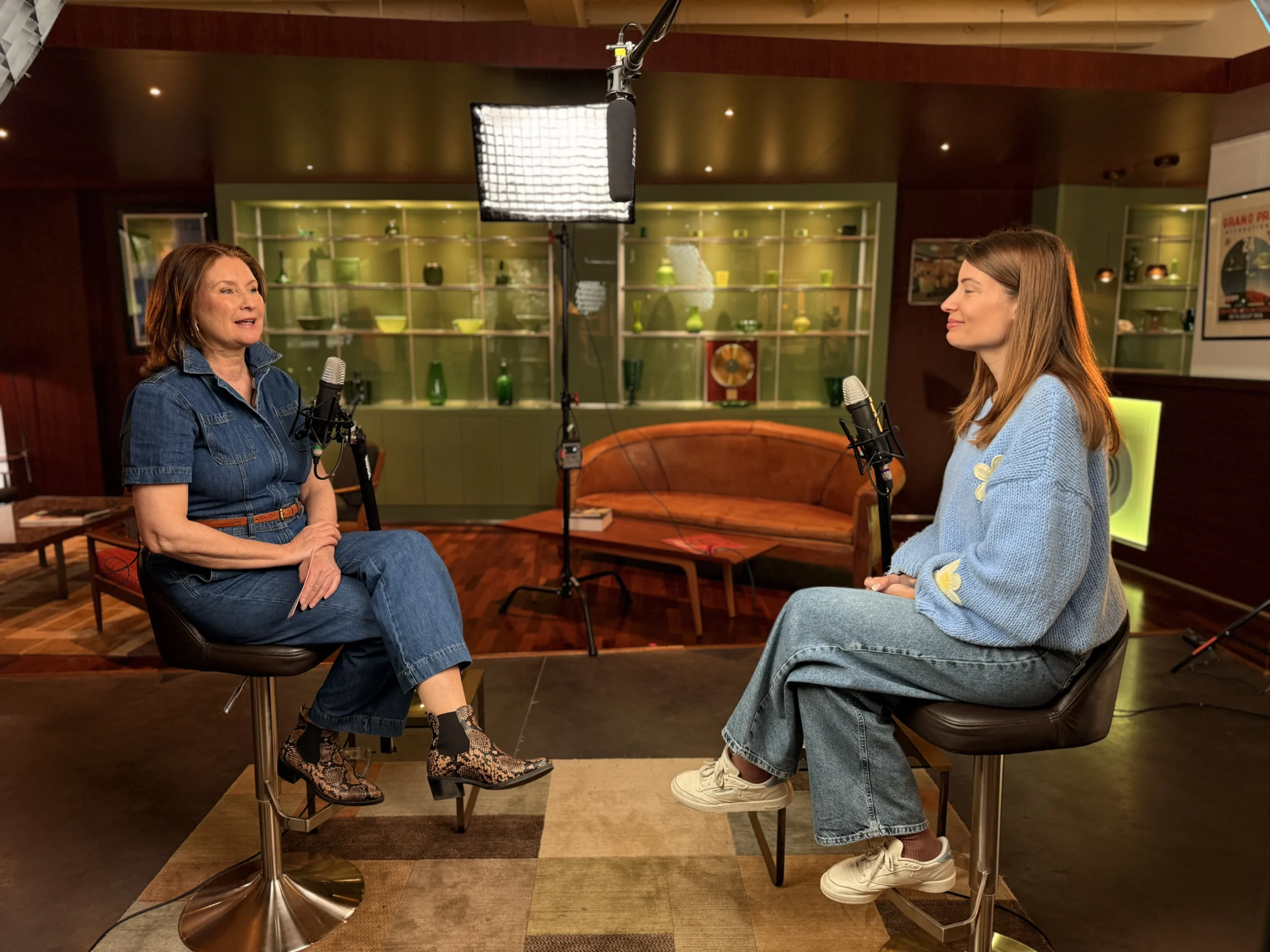
Bring in a different guest each episode and let your host extract genuine insight. The interview format scales well because the guest provides fresh perspective without requiring new editorial direction every week. Brands like ZOE and Marriott Bonvoy have used expert guest conversations to build sustained authority in their respective categories.
Guest coordination adds production time, and without strong editing a 45-minute conversation rarely survives in its raw form. The format works best for B2B brands building thought leadership, professional services firms, and HR or people-focused companies where access to credible external voices is a natural part of the business. Budget between $150 and $1,000 per episode for a managed production, with turnaround typically running three to seven business days.
Roundtable and panel formats: when the conversation is the content
These branded podcast formats work particularly well for industries where debate, diverging viewpoints, and genuine disagreement are expected. Running a roundtable signals that your brand isn’t afraid of nuance, which is a meaningful positioning statement in categories like finance, technology, sustainability, and HR.
Roundtable: recurring voices, recurring loyalty
Three to four participants discuss a defined topic without a rigid Q&A structure. The group works best as a rotating mix of employees, clients, or industry peers. The conversation drives the episode rather than individual answers. The format builds a community feel because loyal listeners return for the dynamic between recurring participants, not just the topic of the week. RBC’s Disruptors uses this approach to position the bank as a credible participant in innovation conversations rather than the subject of them.
Audio cleanup is more demanding with multiple remote feeds, and weak moderation derails an episode faster than any other format. A strong moderator isn’t optional here. They need to create productive disagreement, prevent dominant voices from taking over, and translate specialist points for a broader audience. Budget between $400 and $1,500 per episode and allow four to ten business days for a well-made roundtable.
Panel discussion: debate as a content strategy
A moderated panel responds to a defined question or industry trend, typically with guests who hold different positions. This format performs well for news-adjacent or trend-driven topics and carries high perceived authority when done well. The challenge is operational: scheduling multiple guests simultaneously adds coordination complexity, and panel dynamics can be uneven if the guest mix isn’t deliberately planned for contrast. Legal, finance, tech, and public policy brands are the clearest fit.
Narrative, documentary, and seasonal series: high production, high impact
These formats require more planning, more editorial direction, and substantially more post-production than any conversation-based show. When executed well, they often outperform many conversation-based formats on measures such as brand recall, emotional connection, and press coverage. GE’s The Message hit 1.2 million downloads in eight weeks using scripted narrative. McDonald’s The Sauce investigated its own product mythology across three episodes and generated substantial earned media coverage that would have been difficult to replicate through paid advertising alone.
Narrative and documentary-style episodes
These episodes weave scripted narration, recorded interviews, sound design, and music into a produced story. They sit closer to radio journalism than to a podcast conversation, and they require a corresponding team: an editorial producer, researcher, writer, host, sound designer, and editor working across several weeks per episode. Production costs typically range from $5,000 to $15,000 per finished audio episode, with an eight-to-twelve-episode series often running $60,000 to $120,000 depending on scope.
The format is the right fit for brands with access to unusual stories: customer journeys, company history, social impact campaigns, or investigations into topics where the brand has a legitimate right to report. Brands without a strong editorial story to tell should not default to this format simply because it sounds impressive.
Seasonal series: a finite story with a clear arc
A limited run of eight to ten episodes structured around a single theme, investigation, or campaign objective is the branded equivalent of a limited documentary series. The defined endpoint makes it easier to budget, pitch internally, and distribute as a campaign asset alongside other marketing deliverables. For product launches, brand milestone campaigns, and social issue advocacy, a seasonal series provides enough runway to build engagement without creating an open-ended production commitment your team can’t sustain.
The standard recommendation at StreamBox is to produce eight episodes, release three at launch, and publish the remaining five weekly. Each episode advances one clear campaign message and ends with a measurable call to action. Consistency matters more than volume, and a production buffer of three to four recorded episodes before launch keeps the release cadence reliable even when unexpected delays hit.
Episode length and the completion rate reality
Format choice and episode length are inseparable decisions. The 20-to-35-minute range outperforms longer episodes for most branded and B2B shows. One widely cited benchmark (directional rather than universal) found that 22-minute episodes reached 85% completion compared to 45% for hour-long episodes among C-suite listeners. The practical ceiling for most interview and discussion formats is 30 to 40 minutes before completion rates begin dropping materially.
The first five minutes are the highest-risk window across every format. Many shows lose 10 to 25% of listeners during extended intros, opening sponsor messages, or lengthy scene-setting. A clean hook, a fast premise reveal, and a consistent closing segment reduce early exits regardless of whether you’re running a solo show or a roundtable. If your concept genuinely requires 45 to 60 minutes, divide it into clear chapters and judge performance by minutes consumed and qualified actions rather than completion percentage alone.
Audio versus video: reach and repurposing value by format
This decision intersects with format choice more than most brands realize. Not every podcast format translates equally well to video, and not every brand has the production bandwidth to run both simultaneously. Interview and roundtable formats benefit most from video because facial expressions, on-screen chemistry, and body language create a richer viewing experience.
A single recorded roundtable can yield a full YouTube episode, multiple short clips for LinkedIn and TikTok, and a standalone audio RSS feed from one session. One benchmark reported a 2.49% response rate for video-distributed podcasts versus 1.39% for RSS-only audio, and the content reuse multiplier alone is a strong argument for adding video to any interview or roundtable production. These figures should be treated as directional indicators rather than guarantees, as results vary by industry and audience.
Solo thought leadership and narrative formats can perform just as strongly in audio-only mode. The intimacy of narration and the immersive quality of a produced documentary story don’t always improve with a camera in the room. A sensible approach for most brands is to record video-first for interview and roundtable content, publish the full audio to podcast platforms, publish the full video to YouTube, and build a library of platform-native short clips from a single recording session. That model maximizes reach without requiring a separate production workflow for each format.
How to choose the best podcast formats for brands: a matching framework
Start with three questions before any format decision gets made. Who is your audience and when do they listen? What does your brand want to be known for in this category? And how much internal production capacity do you realistically have across twelve months, not just for a launch burst?
A simple matching framework looks like this:
- Thought leadership and executive visibility: solo or interview format.
- Industry credibility and community building: roundtable or panel.
- Customer stories and emotional brand connection: narrative or documentary.
- Campaign-specific objectives with a defined endpoint: seasonal series.
- Maximum content reuse across platforms: hybrid interview with video production.
Many brands choose the interview format by default because it’s the most familiar. That works if you have access to compelling guests and a host who can extract genuine insight and shape a 45-minute conversation into a 30-minute episode worth listening to. It doesn’t work if you’re booking guests without editorial direction or skipping the post-production that makes the difference between a good recording and a listenable show. The format is only as strong as the production discipline behind it.
Once the format is live, track reach and audience growth through downloads and unique listeners, measure engagement through completion rates and returning listener rate, assess audience quality by how closely listeners match your target customer profile, and monitor conversion through tracking links, landing page visits, and qualified leads. For B2B brands with longer sales cycles, a useful picture of pipeline influence typically takes around six months to develop. Build the measurement framework before launch, not after.
Get the format right before you spend a single production day
The best podcast formats for brands are not the most popular ones. They’re the ones that match what the brand genuinely has to say, what the audience expects to hear, and what the production team can sustain. A well-executed solo show will outperform a poorly produced roundtable every time. A focused seasonal narrative will do more for brand recall than a generic interview series running out of energy by episode eight.
Format drives everything else: budget, cadence, staffing, distribution, and the editorial voice your audience will either bond with or abandon. If that choice isn’t clear yet, it’s worth sitting down with a production partner who can read your brief, audit your capacity, and recommend which podcast format gives your brand the best shot at building an audience that actually grows. At StreamBox, that format-first approach is where every client engagement begins, because getting this decision right is what gives a show its best chance of making it to season two.
Reach out to the StreamBox team for a format audit before you commit to a structure that doesn’t serve your brand. The conversation costs nothing. Spending an entire production season on the wrong format costs considerably more.