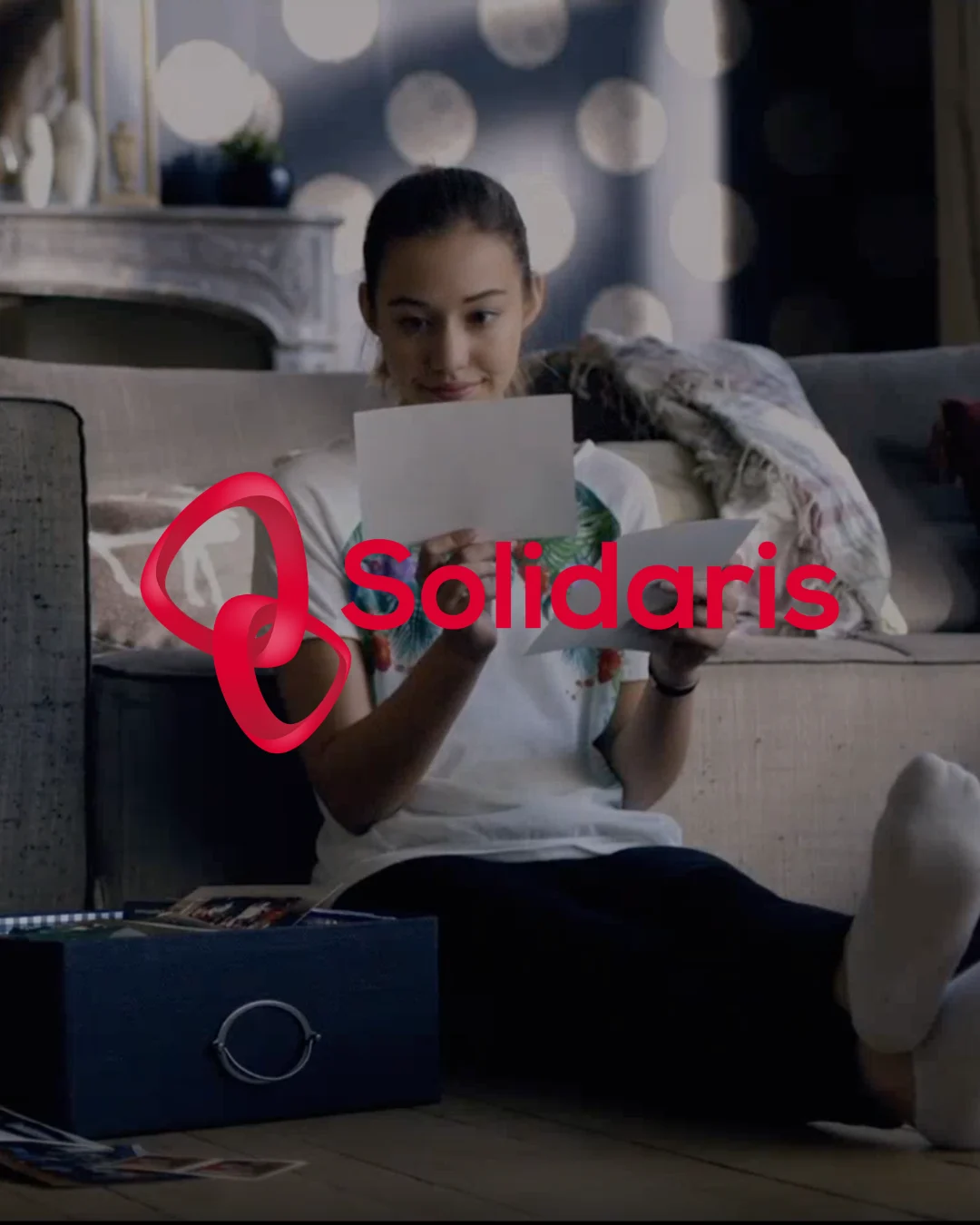
A teenage girl sits on the floor, an open shoebox in front of her. She sorts through old family photos and pauses on one of them. Her mother comes home from shopping. In roughly thirty seconds, this Solidaris ad tells a story of awkwardness, complicity and reconciliation — almost without a single line of dialogue.
The idea: letting a photograph carry the message
The subject is a sensitive one. A teenage girl who doesn’t dare show her teeth — it’s an age, a shyness, something people don’t readily talk about. A film that tried to explain it would instantly feel awkward, and a dental insurance brand handing out lessons on smiling even more so.
The film takes the opposite approach. It explains nothing; instead, it passes an object between characters: a faded school photo found in a box. The entire message lives in what that photo reveals, and in the look shared by the two characters as they discover it together.
The shoot: one house, two actresses, almost no dialogue
Directing a teenager without asking her to perform emotion
This is the film’s central challenge. Ask someone to act self-conscious and you get a grimace. So we work through situations rather than instructions: the box of photos is real, the discovery genuinely happens, and the camera waits. That means long takes, a great deal of patience, and letting go of some of what you had planned.
A real house, with its own light
Living room, kitchen, hallway: the film moves through an actual house, where the light shifts from room to room and changes throughout the day. The challenge is to control it without killing it — because the moment you do, you lose exactly what makes the scene feel real. Continuity is as much a matter of the shoot as it is of the grade.
Looks and gestures instead of dialogue
Without words, everything is carried by faces and hands: the mother’s hand covering her mouth, the daughter’s hand holding out the photo. These shots are filmed close and cut frame by frame. Here, editing rhythm does the work that dialogue would otherwise do.
The payoff: the mother hides behind her own photo
The final gesture says it all: the mother holds up her own teenage school photo in front of her face — braces and all. She’s been there too. The daughter finally smiles, without covering her mouth, and the end card arrives with nothing left to explain.
It’s the most effective mechanism for an intimate subject: showing someone they’re not alone, rather than telling them what to do.
Why this kind of film works
A prevention or insurance film has everything to lose by sounding like a brochure. By anchoring itself in a family scene, it connects emotionally first and informs second — and crucially, it holds back: no one is singled out.
A dialogue-free story also travels far more easily. It can be subtitled without being rewritten, it crosses language barriers effortlessly, and it cuts down into short formats for social media — a content repurposing logic we apply systematically through our social media agency division.
What this project says about how we work
A film like this demands three things: understanding an intention before you shoot it, directing actors with enough restraint to ensure emotion is never performed, and knowing how to shoot in a real location where you don’t control the light. The brand keeps the vision; we take care of everything else.
It’s also what drives every video production project we take on, as you’ll see in our portfolio.