Most marketing teams don’t have a content shortage, they have a content production efficiency problem rooted in their workflows. Drafts pile up in shared drives, approval rounds multiply across email threads, and a video that should take three days can stretch to three weeks of calendar time. The bottleneck isn’t talent or budget: it’s the process that connects one stage of production to the next.
Fixing content output isn’t about working faster or hiring more people. It’s about redesigning the system so that every hand-off, approval gate, and task sequence is intentional rather than improvised. Some brands have already solved this by partnering with studios built around efficient output: StreamBox, for instance, batches a full month of content into a single studio session, eliminating the coordination drag that slows most internal teams. Others have rebuilt their internal operations from the ground up using the same principles.
This article breaks down the four operational levers that drive measurable gains in content production efficiency: diagnosing where workflows stall, building a batch production system, creating a repurposing engine, and tracking the right KPIs to confirm that the changes are holding.
Where content workflows actually break down
Most production delays don’t live inside the work itself. They live between tasks, in the handoffs, approval queues, and tool fragmentation that nobody officially owns. Before reaching for a solution, it’s worth naming the specific choke points clearly.
The approval chain that turns a two-day asset into a two-week delay
Sequential approval steps create dependency chains where one slow responder stalls everything downstream. Writer to editor to subject-matter expert to legal to brand to stakeholder: each stage waits for the prior one to close. Active production time typically represents only 25 to 50 percent of total elapsed time; the rest is waiting. The fix is parallel reviews for independent stakeholders, tiered approval levels based on content risk, and defined SLA deadlines with a named escalation path when someone goes quiet.
Why scattered tools compound every bottleneck
When briefs live in one tool, feedback arrives by email, files sit in a separate folder, and approvals happen in a chat thread, the result is constant context-switching and version confusion. No single person tracks the asset from brief to publication. Work gets repeated, assets go missing, and quality suffers at the hand-off points where context is always thinnest. A unified content workflow automation approach, one system connecting brief, review, and delivery, closes that gap.
The real cost of skipping a content operations framework
Teams without a structured content ops layer often see more revision rounds per asset than the one to two typical of mature operations, along with lower first-pass approval rates. A mature operation targets 60 to 80 percent first-pass approval and 85 to 95 percent on-time delivery. If your team is nowhere near those numbers, the diagnosis is a process problem, not a people problem. Naming that distinction matters because it changes where you invest the fix.
How batch production improves content production efficiency
Batch production is the highest-leverage single change a content team can make. Most teams organize work by deadline; the most efficient organize by task type. That one structural shift eliminates the cognitive overhead of constantly switching between creative modes.
Building a calendar that drives the production schedule
A reactive editorial calendar creates constant urgency and kills throughput. A proactive calendar sets monthly themes, locks pillar topics three to four weeks out, and gives creative teams enough lead time to batch work properly. Each week should start with four decisions already made: one theme, one source asset, one thesis, one CTA. Everything else flows from those four anchors.
Grouping tasks by type, not by deadline
The four batch blocks are: research and ideation, writing and scripting, recording or design, and editing and packaging. Doing all writing in one session, including scripts, captions, carousel copy, and email summaries, eliminates the cost of switching between creative modes. Teams consistently report meaningful reductions in context-switching overhead when they batch by task type rather than by deadline, and that recovered time compounds every week across a full content production workflow.
A practical batch session structure
A single half-day session can produce four to six weeks of derivative content when it’s structured properly. Prep the day before by finalizing scripts, shot lists, and templates. Record all video in one setup, capturing alternate CTAs and B-roll in the same pass. All writing, captions, and carousel copy get drafted in a single block before anyone opens an editing tool. This approach compresses weeks of fragmented effort into one disciplined production window and is the foundation of a repeatable content production workflow.
A repurposing system that multiplies every asset you produce
A single pillar asset (one video, one interview, one podcast episode) can produce six to ten distinct pieces of content without a single new recording. Most teams repurpose reactively and inconsistently. A system turns it into a repeatable, predictable workflow that the whole team can execute without a creative director in the room, and it’s one of the fastest ways to increase content creation efficiency without increasing headcount.
Starting from a pillar asset and working outward
The model works like this: one 20-minute video becomes three to five short clips, a LinkedIn carousel, a text post, an email summary, and three stories. Before any session starts, the ratio should already be fixed. Teams that define the repurposing outputs before they record spend less time in post-production and more time executing to a plan. The asset matrix, source asset to output to primary channel to CTA, becomes the production brief.
The platform adaptation rule: create once, adapt deliberately
Copy-pasting content across platforms underperforms consistently. The six elements to adapt for each platform are: hook, format, opening structure, caption length, CTA verb, and timing. Posting identical content on LinkedIn and TikTok treats both audiences the same, which is why both tend to underperform. The discipline is deliberate adaptation, not repurposing as an afterthought.
A repeatable content atom brief
Ten content atoms can be extracted from any source asset before editing begins: key insight, contrarian point, step-by-step process, example or case study, common mistake, short quote, statistic, FAQ, objection response, and practical checklist. Pre-identifying these atoms before post-production starts cuts editing time significantly and automatically populates the derivative content calendar. The discipline of identifying atoms before anyone opens the editing software is what separates a system from a series of one-off decisions.
Tools with documented impact on content throughput
Not every AI tool that promises efficiency delivers it. The biggest gains come when AI is connected to brand context, templates, approvals, and distribution, not when it’s used as a standalone writing shortcut dropped into an unchanged workflow. The right content automation tools are ones that fit inside a redesigned process, not ones bolted onto a broken one.
Where the strongest evidence points
Adobe GenStudio has the clearest independently substantiated results at the enterprise level: a Forrester TEI study found 47 percent faster production cycles and 35 percent greater content velocity. For content marketing or SEO teams, Jasper handles governed brand voice at scale, while Frase offers a lower-cost starting point for SEO content operations. Descript is particularly effective for video-heavy workflows: transcript-based clip extraction dramatically reduces editing time after batched recording sessions, which makes it a natural fit for the batch model outlined in the previous section.
What teams actually gain versus what vendors promise
Across multiple documented case studies, AI-assisted workflows have reduced time per asset by 35 to 76 percent, but only when the process is redesigned around the tooling rather than inserting a writing assistant into an unchanged workflow. The biggest documented gains concentrate in three areas: time to first draft, briefing prep, and asset repurposing. Raw volume gains without quality controls don’t improve efficiency; they inflate it.
How to evaluate a tool before committing to it
Run a 30-day pilot on one defined content type before expanding. Measure four metrics before and after: brief-to-first-draft time, revision round count, assets produced per team member per month, and cost per approved and published asset. As a practical heuristic, if the tool doesn’t move at least two of those four numbers in 30 days, it’s likely solving a problem that isn’t yours.
What a production partner does to your content pipeline
For many brands, the most efficient workflow isn’t a better internal process. It’s removing the internal production burden entirely. A production partner that handles the full chain, concept through scripting through filming through post through distribution, eliminates every internal hand-off and approval dependency that slows teams down. Done right, it’s the clearest path to content pipeline optimization without rebuilding your internal team from scratch.
The StreamBox model: a month of content in one session
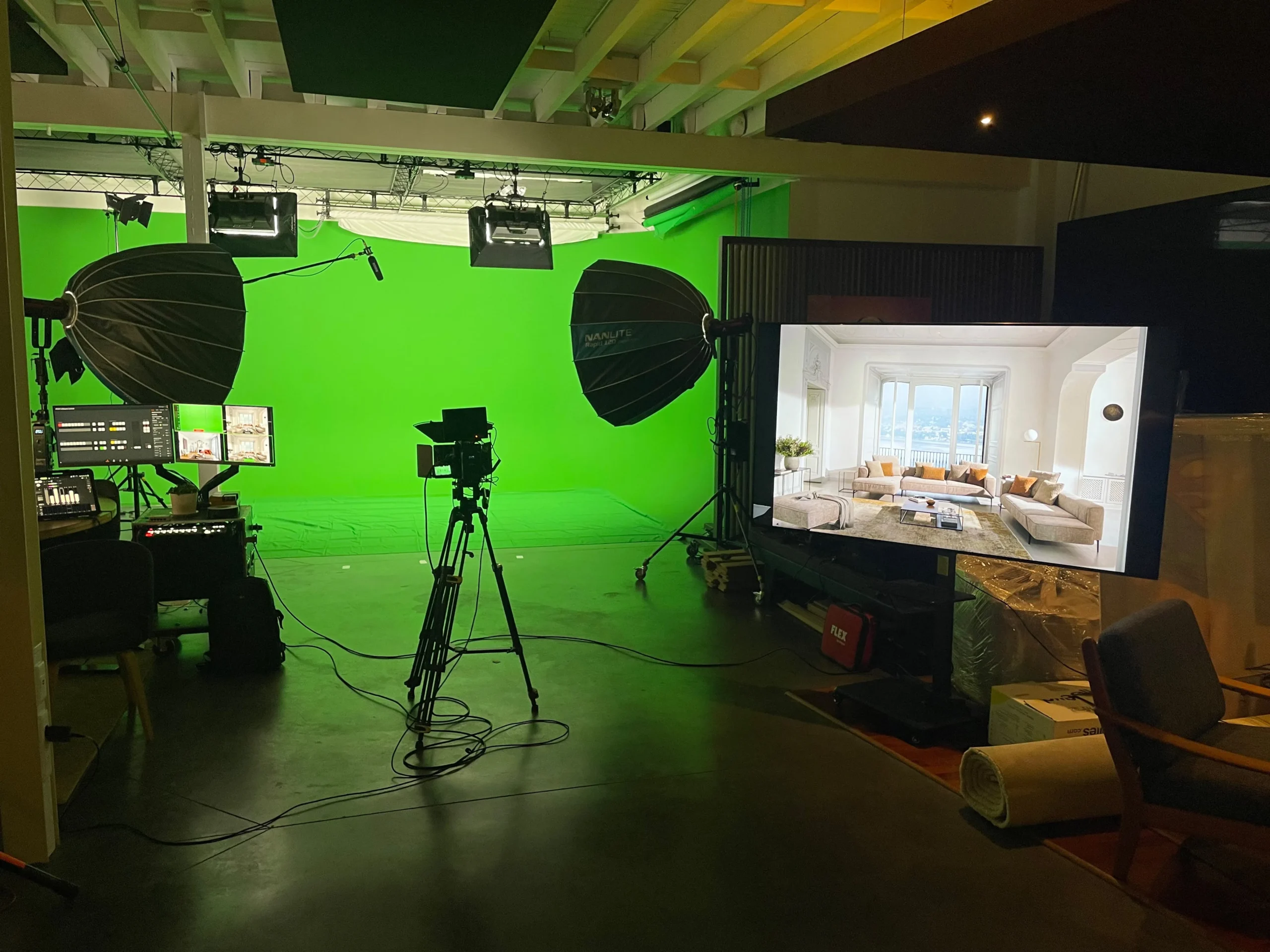
StreamBox’s 440 m² studio near Brussels is built around exactly this model. A client arrives, a dedicated project manager runs the session, and by the end of a single half-day, they leave with enough filmed and scripted material for four to six weeks of content across video, podcast, and social formats. Full post-production, including editing, sound engineering, SEO formatting, and multi-platform packaging, is included. The client’s team has zero post-session production work to manage.
How end-to-end production eliminates the internal hand-off bottleneck
“One point of contact from brief to publication” means no coordination across vendors, no version control issues, no waiting on a freelance editor, and no last-minute compliance reviews slipping through the cracks. StreamBox’s project manager owns the asset from intake to live URL, which collapses an eight-stage hand-off model into a single managed workflow. The TalentBox program extends this same model to individual creators and emerging media personalities who need studio access and distribution strategy without building an internal team.
When outsourcing to a specialist beats building internally
The decision framework is straightforward. As a common industry rule of thumb, if content production requires more than 20 hours per week of internal team time, involves video or audio at broadcast quality, or demands multi-platform distribution with SEO optimization, a dedicated production partner is typically faster and more cost-effective at scale. Industry-reported figures suggest outsourced AI-assisted pipelines can reduce cost per asset by 40 to 60 percent compared to fully loaded in-house costs, and brands that switch to a full-service agency model often reach operational break-even within three to six months.
KPIs to measure content production efficiency
Producing more content is not the goal. Producing more content that is approved, published, and actually used is the goal. The scorecard below gives you a simple framework to track over 30 and 90 days.
The five metrics that matter most
Brief-to-publish time is the single most revealing metric in content operations. It captures everything: how well briefs are written, how smoothly hand-offs flow, how many revision rounds accumulate, and how long approvals take. Target two to five business days for standard assets and under 48 hours for templated variants.
Track it alongside these four supporting metrics, each with a target range:
- Active production time as a percentage of elapsed time, target 25 to 50 percent
- Revision rounds per asset, target one to two rounds on average
- First-pass approval rate, target 60 to 80 percent
- Draft-to-publish rate, target 75 to 90 percent
Realistic baselines by asset type
Short-form video runs $500 to $3,000 per asset fully loaded; blog articles run $500 to $2,500. Don’t blend these into a single average because the outliers will distort every decision you make from that number. Track cost per asset by content family, not as one blended total, and compare within asset types over time rather than across them.
Building a monthly efficiency scorecard
Report monthly, not weekly, using median and 75th-percentile values rather than averages. Outliers (a delayed campaign, a rushed reskin) distort averages disproportionately and lead to the wrong interventions. The five numbers to report each month are: median brief-to-publish time, median active hours per asset, published assets per team member, fully loaded cost per published asset, and revision rounds. Review once per month, act on the pattern over three months, and update your baselines quarterly as the operation matures.
Build the system, then measure whether it holds
Content production efficiency is a systems problem, not a hustle problem. The four levers covered here work together: fix the bottlenecks at the approval and hand-off stages, adopt batch production with a proactive editorial calendar, build a repurposing system that multiplies every asset, and track the right KPIs to confirm whether the changes are actually holding over time.
For brands that want to compress the learning curve entirely, a production partner like StreamBox offers a model built around exactly these principles. One session, one point of contact, four to six weeks of broadcast-ready content, and zero post-session coordination burden on your team. The distinction from a typical outsourcing arrangement matters operationally: one is a patch on a broken process, the other is the process.
Start with one section of this framework this month. Measure your brief-to-publish time before you change anything. Then implement one change, whether that’s parallel approvals, a batch writing session, or a content atom brief, and measure again after 30 days. The system builds from there, and the data tells you what to fix next.