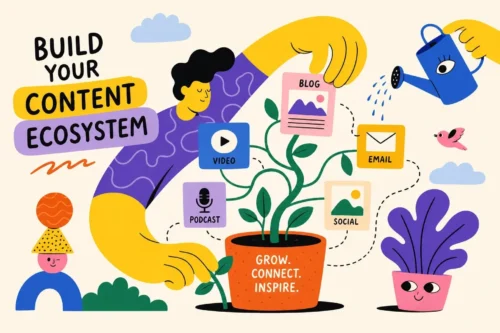
Most brands produce content the same way: someone has an idea, a post gets made, it goes live, and the cycle resets. There’s no architecture connecting assets, no system feeding one piece into another, and no compounding effect building over time. That’s a content treadmill, and it burns budget at a rate that’s hard to justify. A deliberate content ecosystem strategy works differently, every asset connects to others, every piece of content feeds the system, and the whole thing gets more valuable the longer you run it.
At StreamBox, we often observe this pattern with clients who come in with genuinely strong ideas and real things to say. What they’re missing isn’t creativity or budget, it’s architecture. They’re producing content without a system to scale it. This article gives you the practical blueprint to build that system, from the structural model to the editorial workflow and the metrics that tell you whether it’s working.
What a content ecosystem strategy actually is
It’s not a content calendar
A content calendar is a scheduling tool. It tells you what’s going live on which day. A content ecosystem strategy is the architecture behind what gets made, how different assets connect to each other, and where they go across platforms. It defines which topics your brand owns, which content types serve which audience needs, and how the whole system moves people from first awareness to a meaningful decision. Without this architecture, most brands end up with a disconnected library of posts, videos, and articles that don’t reinforce each other and don’t compound over time.
The three layers every ecosystem needs
Break the ecosystem down into three interdependent layers. The creation layer is what you make and why: the briefs, templates, editorial decisions, and brand guidelines that govern what enters production. The distribution layer is where content goes and in what format: the platforms, channels, and native adaptations that get each asset in front of the right audience. The measurement layer is what you track to improve the system: analytics, attribution, and audience signals that feed back into the next production cycle.
Each layer depends on the others. Strong content with no distribution plan goes nowhere. Strong distribution of the wrong content wastes reach. And without measurement, you’re flying blind on what to make next. The rest of this article builds each layer in sequence.
The content ecosystem model: how the layers connect
Think of these three layers as a content ecosystem model, a repeatable framework, not a one-off campaign plan. The creation layer sets intent. The distribution layer sets reach. The measurement layer closes the loop, feeding audience signals back into the next round of briefs. Managing the handoffs between layers is where content operations (content ops) come in: the roles, tools, and workflows that keep production moving without bottlenecks. Whether you’re a two-person team or working with an external studio, defining clear content ops, who owns each stage, which tools track progress, and how approvals move, is what turns a good strategy into a system that actually runs.
The hub-and-spoke model: how content architecture actually works
What the hub does and why it anchors everything
The hub is your most comprehensive, authoritative piece of content on a given topic. It could be a pillar video, a long-form guide, a flagship podcast series, or a definitive industry report. It targets a broad topic, is designed to rank and be shared over time, and every spoke connects back to it. Because of that internal linking structure, the hub accumulates topical authority while the spokes handle the specifics. Without a hub, your content has no gravity. Pieces float independently and rarely compound into anything that builds real brand authority.
How spokes extend your reach without starting from scratch
Spokes are narrower assets that explore subtopics, answer specific questions, or adapt the core message for different channels and audience segments. A spoke could be a short explainer video, a LinkedIn article, an FAQ page, or a client case study. Each spoke references related spokes and always points back to the hub. This structure serves two audiences simultaneously: readers who want to go deeper on a specific angle, and search engines mapping the topical authority of your domain. The more tightly connected the spokes are to the hub, the stronger the whole cluster performs.
A simple pillar-cluster map in practice
Here’s what a functional pillar-cluster map looks like. The hub is a podcast episode on B2B brand storytelling. The spokes include a written summary article, a LinkedIn post series drawn from key arguments in the episode, a short-form vertical video for TikTok and Reels, and a newsletter digest with the main takeaway and a link back to the episode. Each spoke serves a different platform and a different audience behavior, but all roads lead back to the hub.
This model scales because the logic repeats cleanly for every new topic you produce. You’re not reinventing the content architecture each time. You’re applying the same structure to a new subject, which is what makes batch production so efficient once the system is in place.
Repurposing in action: a content ecosystem strategy example
The single session as a starting point
Here’s a concrete scenario to illustrate how this works. A brand records a 45-minute podcast episode end-to-end, concept, scripting, recording, post-production, and multi-platform formatting all handled in one coordinated session. That session produces the master episode. But the recording is also the raw material for everything that follows. One shoot. One day. Multiple weeks of content across every platform the brand operates on. StreamBox is built specifically to support this kind of production workflow, handling each stage so the client can focus on the substance of the conversation.
What comes out of a single episode
The specific assets you can extract from one well-produced episode include:
- The full podcast episode published to Spotify, Apple Podcasts, and YouTube
- Three to five short video clips, 60, 90 seconds each, formatted vertically for TikTok, Instagram Reels, and LinkedIn
- One long-form written article built from the transcript and the episode’s core arguments
- One newsletter issue summarizing the main takeaway with a key quote and episode link
- Quote cards and audiograms for organic social distribution
That’s a content ecosystem strategy in motion. Each asset type serves a different platform behavior and a different moment in the audience’s attention span. Repurposing from a single hub can significantly reduce the need for new shoots, new briefing rounds, and extended approval cycles, though each spoke still benefits from a platform-specific review pass before publishing. The production investment compounds across every channel the brand operates on.
Why this matters for marketing efficiency
Repurposing from a strong anchor asset reduces creative fatigue, keeps messaging consistent across channels, and allows a lean team to maintain a high publishing cadence without proportionally increasing budget. The key is starting with an asset that has enough depth to yield multiple angles. That’s exactly why production quality and editorial direction at the recording stage determine how much you can extract afterward. A shallow conversation produces shallow clips. A well-directed, substantive session produces content that holds up across formats.
Platform-specific formatting: why one post can’t go everywhere unchanged
Each platform has its own native behavior
LinkedIn tends to reward long-form text posts with a strong hook, structured argument, and clear line breaks, it’s a professional context where depth is expected. TikTok and Instagram Reels, based on widely observed platform behavior, favor fast cuts, on-screen captions, and a hook in the first two seconds. YouTube rewards narrative structure, chapter markers, and watch-time retention. Email rewards a personal, curated voice with a single clear call to action. The same clip posted identically across all four will underperform on at least three of them. Format adaptation is not optional; it’s how distribution actually functions.
A practical formatting decision framework for your content ecosystem strategy
For each platform, three decisions need to be made before publishing: the native format (length, orientation, caption style), the engagement hook (what stops someone from scrolling), and the call to action (what you want them to do next). This doesn’t mean rewriting everything from scratch. It means taking the core message from your hub asset and expressing it in the language each platform’s algorithm and audience expects. A spoke is not a copy-paste. It’s a translation.
On LinkedIn, text posts perform well at around 1,200, 1,500 characters with clear paragraph breaks. Native video clips of 30, 90 seconds with captions tend to outperform external links. On TikTok and Reels, the first two seconds carry the entire weight of retention. On YouTube, chapters and a narrative arc matter more than clip length alone. Each of these is a different editorial decision applied to the same source material.
The editorial plan that keeps the whole system running
Roles and ownership: who does what
An ecosystem without clear ownership tends to break down quickly. At minimum, you need four distinct functions covered:
- A content strategist who decides what gets made and maps it to business goals
- A managing editor who sets quality standards and runs the calendar
- Producers or creators who execute the work
- Someone responsible for publishing and distribution
In smaller teams, one person may cover two of these functions, but strategy and execution must stay conceptually separate. When the same person decides what to make and also makes it without a check, both the strategy and the output suffer.
For brands partnering with an external studio, the division is cleaner. As one model, the client team handles strategy and briefs internally while the production studio manages everything from recording through distribution, the client brings the topic and the guest, and the production system takes it from there. That separation of creative ownership and production execution is what makes the model scalable.
Workflow, cadence, and governance basics
Define a repeatable production workflow and don’t deviate from it: brief, create, review, approve, publish, distribute, measure. Every piece in the ecosystem should move through the same gates. Set a publishing cadence you can sustain. Consistency generally outperforms sporadic high-volume publishing, a brand that commits to one strong hub piece per month and a handful of well-crafted spokes will typically build more durable authority than one that floods channels with low-effort content for a quarter and then goes quiet.
Establish governance rules for brand voice, naming conventions, and approval requirements early. As the team scales or agency partners are added, these rules prevent quality degradation. A shared editorial calendar is enough to start. The tool matters far less than the habit of using it together and treating the workflow as non-negotiable infrastructure, not an optional guideline.
What to measure to know if the ecosystem is working
Track performance at both the hub and spoke level. For hubs, the core metrics are organic traffic, backlinks, time on page, and content-attributed conversions. For spokes, track reach, engagement rate, and click-through back to the hub. These tell you whether the distribution layer is feeding the hub with new audiences or functioning as a dead end.
Over time, look for compounding patterns. Are older hubs continuing to drive traffic months after publication? Are spokes pulling new audiences into the core content? The goal of measurement isn’t just to justify budget, it’s to identify which topics, formats, and channels are working so the next production cycle gets smarter. Brands that track at the cluster level, not just the individual post level, are the ones that build genuine content authority over time.
Building an ecosystem worth coming back to
A content ecosystem strategy is not a one-time project. It’s a system that gets stronger every time you add a well-structured hub and a set of spokes that distribute it intelligently. The compounding effect is what separates brands with real content authority from those perpetually chasing the next post. Start with one anchor asset, build the spokes around it, and repeat the model.
The architecture described here is learnable and repeatable. The hub-and-spoke structure, the repurposing workflow, the platform formatting decisions, the editorial governance, none of it requires a massive team or an enterprise budget. It requires clarity about how the pieces connect and the discipline to run the system consistently. For teams that want to move faster and extract more from every production session, partnering with a studio that understands both the editorial logic and the distribution mechanics makes the architecture real rather than theoretical.
The system works. The habit of using it is what separates brands that talk about content strategy from the ones that actually ship it. If you’re ready to put a content ecosystem strategy in place, get in touch with the StreamBox team to walk through what a first hub-and-spoke production session would look like for your brand.