Most companies that launch a branded podcast spend the first six months obsessing over downloads. That’s the wrong number. A show with 800 downloads per episode can dramatically outperform one with 8,000 downloads if the format is built around the right monetization model. If you’re asking how a company can make money from a podcast, the download count is just one variable in a much more useful equation.
This article walks through six proven ways a company can generate real revenue from a podcast in 2026, with actual B2B numbers to benchmark against and a framework for estimating ROI before you record a single episode. Whether you’re a marketing leader evaluating the investment case or a brand already publishing and wondering why nothing is converting, the path forward starts with understanding which model actually fits your goals. At StreamBox, we’ve built monetizable podcast formats for companies across multiple industries, and the pattern is consistent: the shows that earn are the ones designed to earn from day one.
The two monetization paths every company must understand first
Before you choose a revenue model, you need to decide what kind of podcast you’re actually building. That decision shapes every other choice you’ll make, and it determines which corporate podcast strategy will actually work for your goals.
Media-brand vs. owned-brand podcasting
A media-brand podcast is built to attract a broad outside audience and generate revenue directly from that audience through advertising, subscriptions, or affiliate deals. An owned-brand podcast is a marketing channel designed to drive leads, trust, and pipeline for the company’s core business. Most companies are building the second type but trying to monetize like the first. That mismatch is the single biggest reason branded podcasts fail to generate measurable returns. The fix is simple: match your monetization model to the type of show you’re actually running.
How audience size maps to revenue model eligibility
Under 1,000 downloads per episode, direct ad monetization is weak. Subscriptions, affiliate offers, and lead generation work better at that stage. Around 2,000 to 5,000 downloads per episode, sponsorships start to become viable. For B2B shows, though, even 500 qualified downloads can generate significant pipeline if the episode structure guides listeners toward a specific next step. Download count is an input, not a verdict.
How a Company Can Make Money From a Podcast: Sponsorships and Brand Partnerships
Sponsorships are the most visible form of podcast revenue and the model most companies reach for first. When structured correctly, they can generate meaningful income even for mid-sized shows.
What CPM rates actually look like in 2026
Ad rates vary significantly by deal type. Host-read deals sit at roughly $25 to $50 CPM for standard shows, with top-tier inventory reaching $60 to $120 CPM. Programmatic ads run $5 to $25 CPM. Network deals typically land between $15 and $30 CPM. To put that into practical terms: a 30-minute show at 3,000 downloads with two host-read mid-rolls at $35 CPM generates roughly $210 per episode, or about $5,400 per year on a biweekly publishing schedule. That’s a useful baseline for any company evaluating whether sponsorship revenue can offset production costs.
How to land brand partnerships before you hit scale
Sponsors care about audience quality more than raw size. A B2B podcast targeting CFOs at mid-market companies is more valuable at 800 downloads than a general business show at 5,000. A few practical steps get you there faster: build a media kit with listener demographics and firmographic data, approach vendors whose tools your audience already uses (so the pitch is easy), and offer an introductory deal tied to a custom tracking URL or discount code so the sponsor can measure their own ROI. That last point removes the biggest objection most sponsors raise before signing.
How a Company Can Make Money From a Podcast: Lead Generation
For most B2B companies, the highest-value use of a podcast isn’t selling ad space, it’s shortening the sales cycle. Podcast lead generation consistently delivers strong ROI for companies with a clear core offer, and it scales at audience sizes that wouldn’t qualify for meaningful sponsorship revenue.
Real case study numbers that prove the model
Client names are withheld by request; data is drawn from StreamBox-managed accounts.
One SaaS company generated $480K in closed-won revenue from podcast-sourced deals in nine months, with 68% of guests converting to sales conversations. A cybersecurity firm produced $2.1M in pipeline after six months of publishing, averaging 3,200 downloads per episode. A Series B SaaS platform targeting CFOs attributed $350K in qualified opportunities to podcast touchpoints within the same nine-month window. These numbers reframe what “monetization” actually means for a company podcast. The revenue isn’t coming from ad slots; it’s coming from relationships built at scale.
Episode structures that turn listeners into qualified leads
The lead-gen model works when episodes are designed to attract the right guests and create a natural path into a sales conversation. The structures that perform reliably share a few core traits. The guest-as-prospect model invites ideal clients as podcast guests, turning a 45-minute interview into a warm relationship before any sales outreach happens. The problem-framing format builds episodes around the specific pain points your company solves, attracting listeners who are already in-market. CTA architecture ties one specific call to action per episode to a dedicated landing page, not a homepage, so you can measure attribution from the first episode forward.
Paid subscriptions and affiliate revenue: direct listener income
Not every company should chase subscriptions, but for shows with a loyal niche audience, paid tiers add a revenue layer that compounds over time without depending on advertiser relationships.
Which subscription platforms are worth using in 2026
Supercast is a strong choice for podcast-first paid feeds with full audience ownership. Patreon works well for perk-based membership and community engagement. Apple Podcasts Subscriptions offers native checkout for Apple-centric audiences but limits your reach to one ecosystem. Spotify for Creators is the easiest entry point for free hosting and basic monetization, though it’s region-dependent and the platform controls more of the subscriber relationship than you might expect. For a company starting a premium tier, Supercast plus Apple Subscriptions covers the widest practical base while keeping your audience data in your hands.
Where affiliate and product revenue fit into a branded show
Affiliate revenue works best when your brand can authentically recommend third-party tools your audience already uses or is actively evaluating. Product revenue, covering courses, templates, consulting retainers, and workshops, is one of the most reliable income streams for expertise-driven company podcasts because there’s no minimum audience size requirement. The key to positioning a product offer inside an episode without sounding transactional is straightforward: tie the mention to the episode topic, lead with the listener’s problem, and present your offer as a natural next step rather than an interruption.
Estimating revenue vs. production cost before you commit
A company doesn’t need a massive audience to profit from a podcast. It needs a realistic cost-and-revenue model before committing to a format and cadence.
Production cost benchmarks for a professional branded podcast
Production costs break down by scope and support level. A lean outsourced setup costs $200 to $600 per episode and usually covers basic editing and cleanup, but rarely includes strategy, clips, or distribution support. A standard company podcast with editing, publishing, and asset creation runs $500 to $1,500 per episode. A premium brand show with editorial direction, clips, sound engineering, and full distribution support runs $1,500 to $5,000 per episode. At a biweekly cadence, a $1,000-per-episode show costs roughly $26,000 per year, a real number a marketing leader can take to a budget conversation.
A simple ROI framework for the first 90 days
Start with your primary monetization model: lead gen, sponsorship, or subscription. Then estimate the value of one converted outcome. The math looks different depending on your model, so it helps to run the numbers side by side:
- Lead generation: For a B2B company closing $20K service deals, the podcast breaks even if it contributes two qualified leads per quarter.
- Sponsorship: At 3,000 downloads per episode, two host-read mid-rolls cover roughly $5,400 per year in direct revenue.
- Subscriptions: 100 paying subscribers at $10 per month generates $12,000 annually with zero advertiser dependency.
The 90-day action plan is straightforward: choose two or three models, assign one primary KPI to each, and track episode-to-outcome attribution from episode one. Don’t wait until month six to measure what’s working.
Why your podcast format is a monetization decision, not just a creative one
The format a company chooses, and the production quality behind it, directly determines which monetization models are available to you. A poorly produced show won’t attract sponsors. An inconsistently published feed won’t retain paid subscribers. A show with no SEO strategy won’t grow the audience needed for meaningful ad revenue.
How production quality determines sponsorship value
Sponsors evaluate audio quality, episode consistency, and brand positioning before they evaluate download numbers. A broadcast-ready show signals professionalism and gives a sponsor confidence that their brand association is safe. Premium sound engineering and editorial direction are not production luxuries. They’re the foundation of a sponsorable asset. A show that sounds like it was recorded in a stairwell doesn’t get a $40 CPM, regardless of how niche the audience is.
How StreamBox builds podcast formats designed to earn
At StreamBox, we structure podcast formats around monetization goals from the first brief. That means choosing the right format, interview, roundtable, or seasonal series, based on whether the show is optimized for lead generation, sponsorship, or audience growth. It means handling full post-production, sound engineering, and multi-platform distribution so the show reaches listeners on Apple, Spotify, YouTube, and LinkedIn without the client managing six different workflows. SEO optimization for podcast platforms and YouTube is built into every project, so the show grows organically rather than depending entirely on paid promotion or existing audience size.
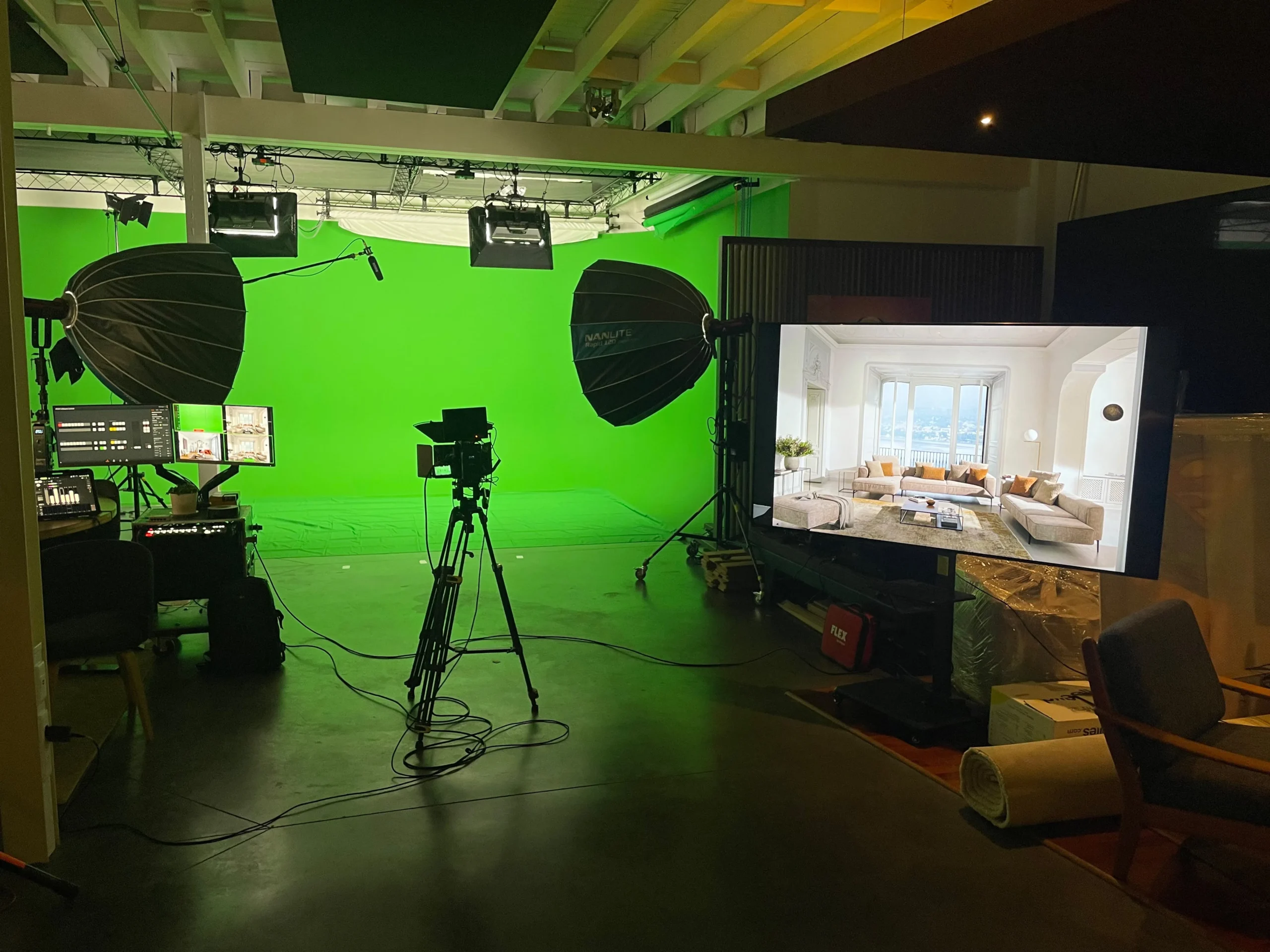
StreamBox’s batch-production model lets companies record weeks of content in a single half-day session inside our 440 m² (roughly 4,700 sq ft) studio near Brussels. That structure reduces the per-episode cost significantly and maintains the publishing consistency that both sponsors and subscribers expect. A company that records six episodes in one day is a fundamentally different kind of content operation than one that produces reactively, rushing out a single episode every two weeks. That consistency is what makes a podcast into a monetizable asset rather than an ongoing production burden.
Build the infrastructure now, earn for the rest of the year
The path to podcast monetization is straightforward once you stop measuring the wrong things. For B2B companies at any audience size, lead generation is the most reliable model and the one that requires the least scale to work. Sponsorships scale with audience quality, not just quantity. Subscriptions and affiliate revenue add compounding income for shows with a loyal niche. The math works once you align format, production quality, and distribution to a defined revenue outcome.
The companies building monetizable podcast infrastructure now won’t be starting from scratch when the market consolidates further in late 2026. They’ll have 12 months of attributed revenue data, a growing listener base, and a show that sponsors already know. That’s a meaningful head start. If you want to understand exactly how a company can make money from a podcast, and build a format designed to earn from episode one, get in touch with our team at StreamBox and we’ll map the right model to your goals.